Financing Solutions to Accelerate Low-Carbon, Resilient Real Estate
Transforming Canada’s building sector requires more than strong research or well-designed frameworks. It requires stakeholders to align the practices that connect building performance, valuation, and finance.
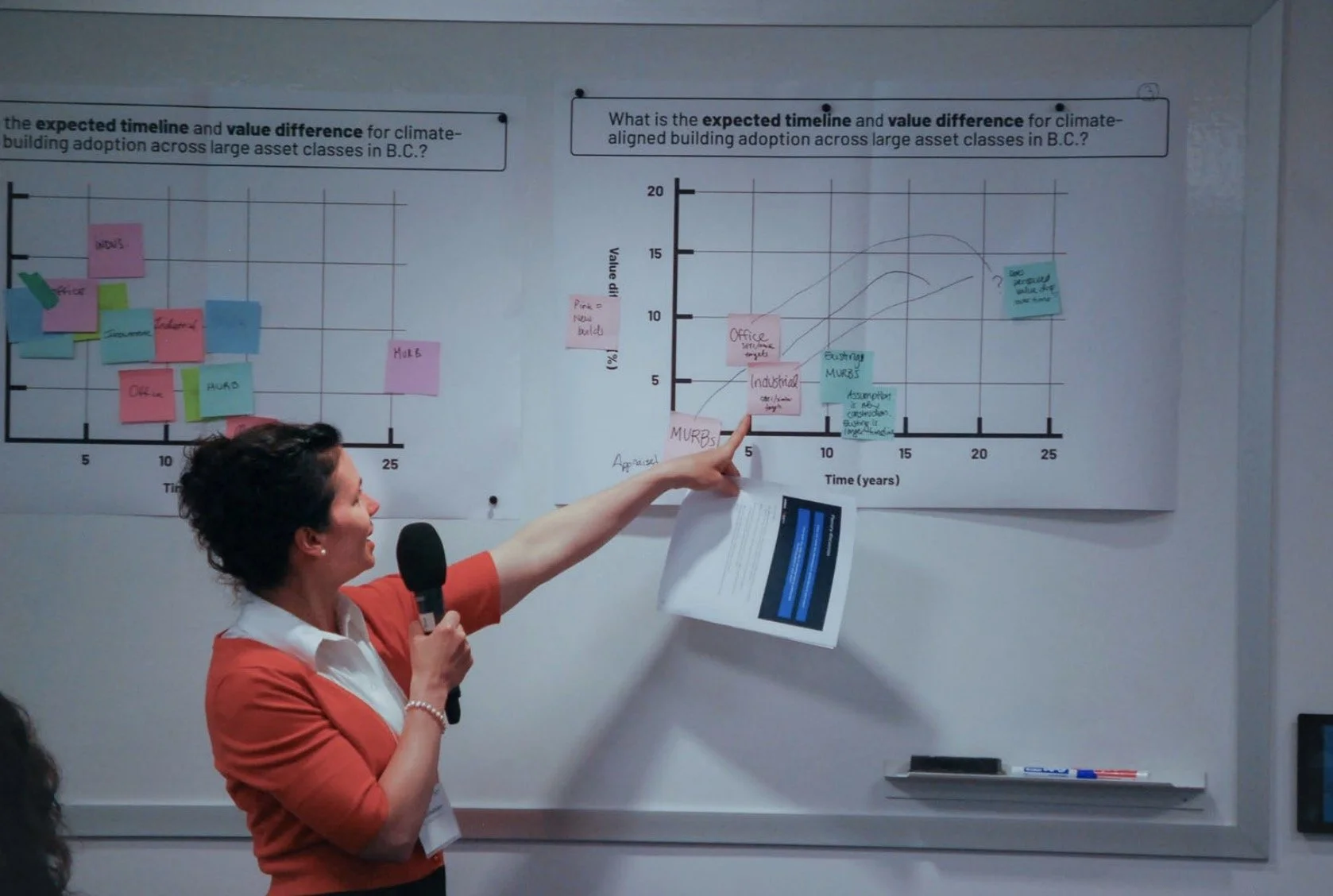
In 2025, Affine Climate Solutions brought this approach to life through two national industry workshops, held in Vancouver and Toronto, as part of the Banking on Buildings Program. In partnership with a growing coalition of financial institutions and convening support from SFU Renewable Cities, these sessions convened more than 100 professionals from the real estate, finance, regulatory, and non-profit sectors to test ideas, challenge assumptions, and help shape practical solutions for low-carbon, climate-resilient real estate.
How We Work
Rather than presenting finished solutions, Affine used these workshops as working sessions. Participants engaged with draft research findings and practical early-stage frameworks, testing them through facilitated discussions and table exercises. This approach ensured that outputs are grounded in market realities and usable by frontline decision-makers.
We brought together participants from financial institutions, utilities, green building groups, policy organizations, climate-focused non-profits, investors, insurers, developers, asset managers, appraisers, and consultants, to ensure a wide range of knowledge and input.
What we Heard
While perspectives varied, a common motivation emerged: a need for credible, evidence-based ways to connect building performance with financing, valuation, and risk decisions.
In Vancouver, conversations emphasized clarity and the role of insurance and regulation in shaping market behaviour. In Toronto, discussions focused more heavily on translating performance into financial language – from debt-service coverage and underwriting to cap rates and default risk. Together, the sessions reinforced the importance of consistent definitions and metrics as well as coordinated collective action to accelerate sustainable real estate.
Across both cities, participants highlighted a persistent “valuation gap.” Climate-aligned buildings deliver real benefits – lower operating costs, reduced default risk, improved resilience – yet these advantages are not consistently reflected in lending terms or appraisals. Many attendees reported that they saw the workshops as an opportunity to help close that gap.
What We’re Doing with the Feedback
Insights from both workshops are directly informing the next phase of the Banking on Buildings Program. Participants’ input is being used to refine performance criteria, simplify frameworks, strengthen the business case narrative, and shape upcoming financing pilots across asset classes and regions.
Most importantly, these engagements reflect how Affine works: by convening diverse voices, grounding climate action in financial realities, and co-developing tools that can be scaled to align real estate finance with emerging climate mandates. Financial institutions that embed resilience and emissions criteria into lending practices not only reduce portfolio risk but also unlock new opportunities for growth in a rapidly changing market. As regulatory expectations evolve, this kind of collaborative groundwork will be essential to accelerating climate-aligned real estate across Canada.
We are grateful for support from Forestry Innovation Investment’s Wood First Program and The Atmospheric Fund (TAF), whose contributions made these workshops possible.