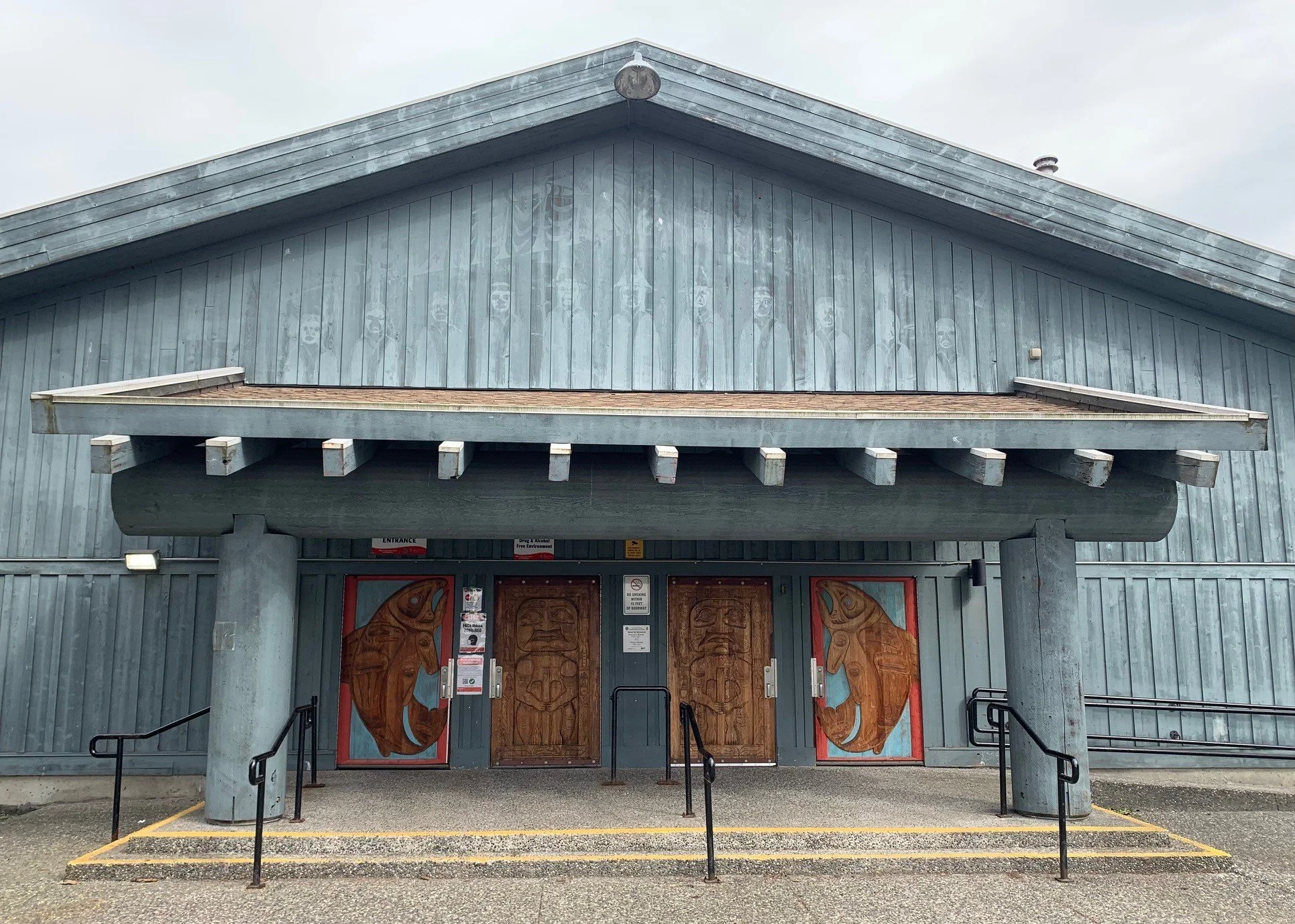
Designing for Net Zero: Lessons from the Squamish Nation’s Chief Joe Mathias Centre
We supported planning for a deep retrofit pilot to demonstrate the financial and community value of fully electrifying a cultural hub to support long-term net-zero and resilience goals.
Across Canada, many communities are grappling with the same challenge: how to meaningfully decarbonize existing buildings without compromising affordability or community function. This challenge is often paired with a deeper responsibility – to align climate action with long-term stewardship, resilience, and care for community members across generations.
The Chief Joe Mathias Centre (CJMC), a cultural and recreational hub for the Squamish Nation offers a powerful example of how this can be done. Built in the early 1990s, the Centre supports year-round programming, community gatherings, and essential services. With major mechanical systems reaching the end of their useful life, the building became an ideal candidate to test what a credible, net-zero-aligned retrofit could look like in practice.
Testing Full Electrification in a Real-World Setting
Rather than defaulting to conventional equipment replacement, the Squamish Nation chose to use this opportunity to pilot an approach that could inform future retrofit decisions across its building portfolio. The objective was not only to reduce emissions, but to understand the technical feasibility, financial implications, and long-term value of moving away from fossil fuels entirely.
One of the most significant questions explored through the project was whether a fully electric retrofit could realistically meet the needs of a complex, high-use community facility. Hybrid systems that retain natural gas for peak heating are often perceived as a safer or more economical option. Through detailed energy modelling and schematic design, however, the project demonstrated that a fully electric solution could meet heating, cooling, and domestic hot water demands without a prohibitive cost premium, while avoiding the long-term emissions and transition risks associated with gas infrastructure.
Long-Term Value, Health, and Resilience
The retrofit strategy focused on electrifying HVAC systems, domestic hot water, and commercial kitchen equipment, supported by rooftop solar photovoltaics. Together, these measures were projected to reduce greenhouse gas emissions by approximately 87%. Importantly, the project explored less common retrofit components, such as fully electrified commercial kitchen equipment, helping to test market readiness and identify supply limitations that are often overlooked in early planning.
Beyond emissions, the project highlights the broader benefits of deep retrofits when evaluated through a long-term lens. A Total Cost of Ownership (TCO) analysis compared like-for-like equipment replacement with a deep electrification pathway over a 60-year post-retrofit lifespan. While the electrified option required higher upfront capital investment, the analysis showed that lower energy costs, improved system efficiency, and avoided exposure to natural gas price escalation could offset those costs over time. In other words, the “cheapest” option upfront was not the most cost-effective option over the life of the building.
From Pilot Project to Portfolio Learning
Health and resilience were equally central to the project’s design. Eliminating gas-fired kitchen equipment improves indoor air quality, reducing exposure to pollutants for staff, elders, children, and other vulnerable community members. New ventilation and filtration systems further protect indoor environments during wildfire smoke events – an increasingly common climate impact in B.C.
The project reframed the Centre’s role during extreme weather. Post-retrofit, CJMC is envisioned as a community resilience hub, capable of providing safe, climate-controlled space during heat waves, cold snaps, and emergencies. While a battery storage system was investigated, cost and duration constraints led the team to pursue alternative backup power solutions, with an emphasis on lower-emission fuel options. This transparent evaluation process is itself an important outcome, offering practical insight into where current technologies succeed and where further innovation is needed.
Perhaps most importantly, the CJMC retrofit demonstrates the value of using pilot projects as learning platforms. The goal was not to create a one-off success, but to test assumptions, build internal capacity, and develop replicable processes that can support future decarbonization efforts across the Nation’s building stock.
As more communities face decisions about aging infrastructure and climate commitments, projects like the Chief Joe Mathias Centre illustrate what becomes possible when retrofit planning is guided by long-term value and community priorities.
Beyond Carbon: Why Mass Timber Is Gaining Ground in B.C. Construction
Our Total Cost of Ownership (TCO) analysis shows that mass timber can strengthen climate performance and long-term value beyond upfront cost.
Mass timber is moving from niche to mainstream in British Columbia and other Canadian provinces. Years of coordinated effort by governments, industry, Indigenous partners, and post-secondary institutions have grown local manufacturing capacity, strengthened workforce skills, and increased market confidence. The result: as of December 2023, there were 370 mass timber buildings in B.C., according to the Government of B.C.’s Mass Timber Action Plan Progress Update. A2024 BC Building Code revision raised the height limit for encapsulated mass timber construction from 12 to 18 storeys, further encouraging uptake.
Supported by BC Forestry Innovation Investment’s (FII) Wood First Program, Affine Climate Solutions developed a Total Cost of Ownership (TCO) methodology comparing mass timber with conventional construction materials across nine decision factors.
Beyond Carbon: Housing and Delivery Benefits
Beyond its climate benefits, mass timber offers a compelling opportunity to address housing supply challenges. Prefabricated and modular approaches can shorten construction schedules and reduce site disruption. Recent theoretical costing studies suggest mass timber can be competitive with concrete and steel under the right conditions – but upfront construction costs tell only part of the story.
Our report highlights why TCO matters when deciding whether to incorporate mass timber and other emerging materials and technologies into construction projects. While upfront costs for mass timber can still be higher – and insurance, financing, and procurement risks remain a factor – TCO analysis provides a more complete picture of long-term costs and benefits. When operational performance, occupant wellbeing, embodied carbon, schedule impacts, and long-term asset value are considered together, mass timber’s advantages become clearer.
From Case Study to Market Insight
Using a hybrid mass timber affordable housing project under construction in Vancouver as a case study, we compared nine decision factors across mass timber, concrete, and steel systems. Applying real project data to a modeled pro formaallowed us to test assumptions and surface trade-offs across upfront capital costs, lifecycle costs and performance, environmental outcomes, and occupant benefits. While modeled comparisons have limitations – costs fluctuate over time, making accurate projections a challenge – the approach offers a comprehensive framework for informed decision-making.
The takeaway is not that mass timber is always the lowest-cost option today, but that its risk profile is improving. At the same time, mass timber provides significant embodied carbon reductions and end-of-life benefits through reuse, repurposing, and biodegradability. As supply chains mature and more projects reach completion, costs are expected to decline and insurance and financing barriers to reduce. As a locally sourced material, mass timber strengthens regional economies and reduces exposure to global supply chain volatility.
For owners and developers considering mass timber, early and integrated decision-making is critical. Engaging insurers and financiers upfront, selecting experienced design and construction teams, and considering alternative delivery models can significantly improve outcomes. Equally important is starting with mass timber as a primary design intent – rather than treating it as a late-stage substitution – so its schedule and carbon benefits can be fully realized.
Mass timber is not just a construction choice. In many cases, it can be a strategic investment in climate-aligned housing and long-term asset performance.
Comparing Net Zero Retrofit and New Construction Pathways in False Creek South
Retrofitting often costs less and emits far less carbon than rebuilding – but the right choice depends on priorities. We explored the trade-offs between affordability, density, cost, and climate outcomes.
As cities grapple with aging buildings, climate commitments, and affordable housing shortages, the question of whether to retrofit or redevelop is becoming central to urban planning. For False Creek South - a Vancouver neighbourhood where two-thirds of homes are non-profit or co-operative - the answer carries long-term implications for carbon emissions, affordability, and housing availability.
Affine Climate Solutions was selected by the False Creek South Neighbourhood Association (FCSNA) and its RePlan committee to complete a study comparing two pathways for Creekview Housing Co-operative: a net-zero, climate-resilient retrofit, or complete redevelopment with new affordable and market units. Amid upcoming lease expiries and accumulating deferred maintenance across many homes in False Creek South, the Creekview case study offered a critical opportunity to assess the environmental and financial impacts of each option.
Comparing Retrofit and Redevelopment Pathways
Our analysis evaluated five key drivers: density, capital costs, affordability, livability, and carbon (both operational and embodied). The findings showed that retrofitting existing buildings can deliver lower emissions and greater affordability than new construction.
Over a 45-year horizon, the retrofit scenario was projected to generate 92% less carbon than redevelopment, with embodied carbon accounting for most emissions in both scenarios. Lifetime costs were also considerably lower, with the retrofit scenario projected to cost 90% less than redevelopment. While redevelopment could increase the number of housing units by approximately 80%, it would likely be financially unviable to maintain the current level of deep affordability.
From Comparison to Informed Choice
To fully inform future planning, additional work could strengthen the comparison, including a detailed pro forma for new construction, refined upgrade scopes for a retrofit scenario, and a deeper evaluation of community and social impacts.
For Affine, this project reflects the kind of integrated, evidence-based analysis we bring to housing providers, governments, and real estate developers. By combining carbon modelling, cost analysis, livability considerations, and climate-aligned financing insights, we help clients navigate complex decisions that balance environmental performance with long-term social value.